Case Study

Gauteng Department of Roads and Transport

Establishing coninuous revenue control across a high-volume provincial transport environment

RIMS connects fragmented systems, payments and people to deliver continuous control, complete visibility and trusted revenue outcomes.

Measurable results

99.54%

Average cash-up reconciliation achieved

Quarter 4 2025/26 operational sample

100%

Cash-ups captured, completed and signed off

Quarter 4 2025/26 operational sample

120+

Operational
users

Across finance, licensing and enforcement functions

R63.17m

Paid against
R103.39 million

Recorded under debt-management arrangements between 2018 & 2026

R5.7b

Approved annual
revenue

or verified transaction-volume metric (FY 25/26)

THE CHALLENGE
THE CHALLENGE

The Department operated within a fragmented revenue environment. Reconciliation was manual and periodic, payment references were inconsistent, and duplicate or unrecognised payments required investigation. Revenue allocation across institutions was difficult to govern, while reporting could lag by four to six weeks. This created a structural control gap between revenue collected, banked, allocated and reported.

THE SOLUTION
THE SOLUTION

RIMS was introduced through phased implementation from 2008 across finance, licensing and enforcement functions. It established a central control layer that integrated payment, banking and operational data. The platform introduced continuous reconciliation, standardised references, duplicate-payment detection, automated revenue-split calculations, near-real-time payment verification and transaction-level traceability across channels and institutions.

THE OUTCOME
THE OUTCOME

RIMS created a governed revenue flow across systems, institutions and accounts. Reconciliation became continuous, payments could be verified in near real time, revenue splits followed defined rules, and reporting became more timely, structured and evidence-based.

Before RIMS
Reconciliation was manual and periodic.
Revenue visibility was delayed across systems and accounts.
Reporting lagged by several weeks.
Payment recognition depended on manual investigation.
Revenue allocation across institutions was fragmented.
Debt and stock records relied on disconnected documents and spreadsheets.
After RIMS
Reconciliation became continuous and system-driven.
Payments could be verified in near real time.
Transactions became traceable from source to banked record.
Revenue splits and allocations followed defined rules.
Debt-management processes became centralised and automated.
Reporting became more timely, structured and evidence-based.
Key control outcomes
Automated allocation using unique payment references to the correct institution or authority.
Clearer revenue splits between the Department, registering authorities and agents.
Centralised debt agreements, instalment tracking and automated payment reminders.
Structured M99 and daily cashbook reporting with complete audit traceability.
Face-value stock control using serial numbers and distribution records.
Role-based access and transaction-level audit trails.
Why it worked

Traditional approaches control individual parts of the revenue chain, such as payment processing, banking, operational recording and financial reporting. However, these systems do not necessarily govern the movement of revenue between them.

RIMS addressed this control gap by integrating the relevant environments, standardising payment data and embedding reconciliation into the transaction flow. This created transaction-level traceability across systems and institutions and shifted the Department from retrospective verification to continuous revenue control.

Revenue integrity improvement

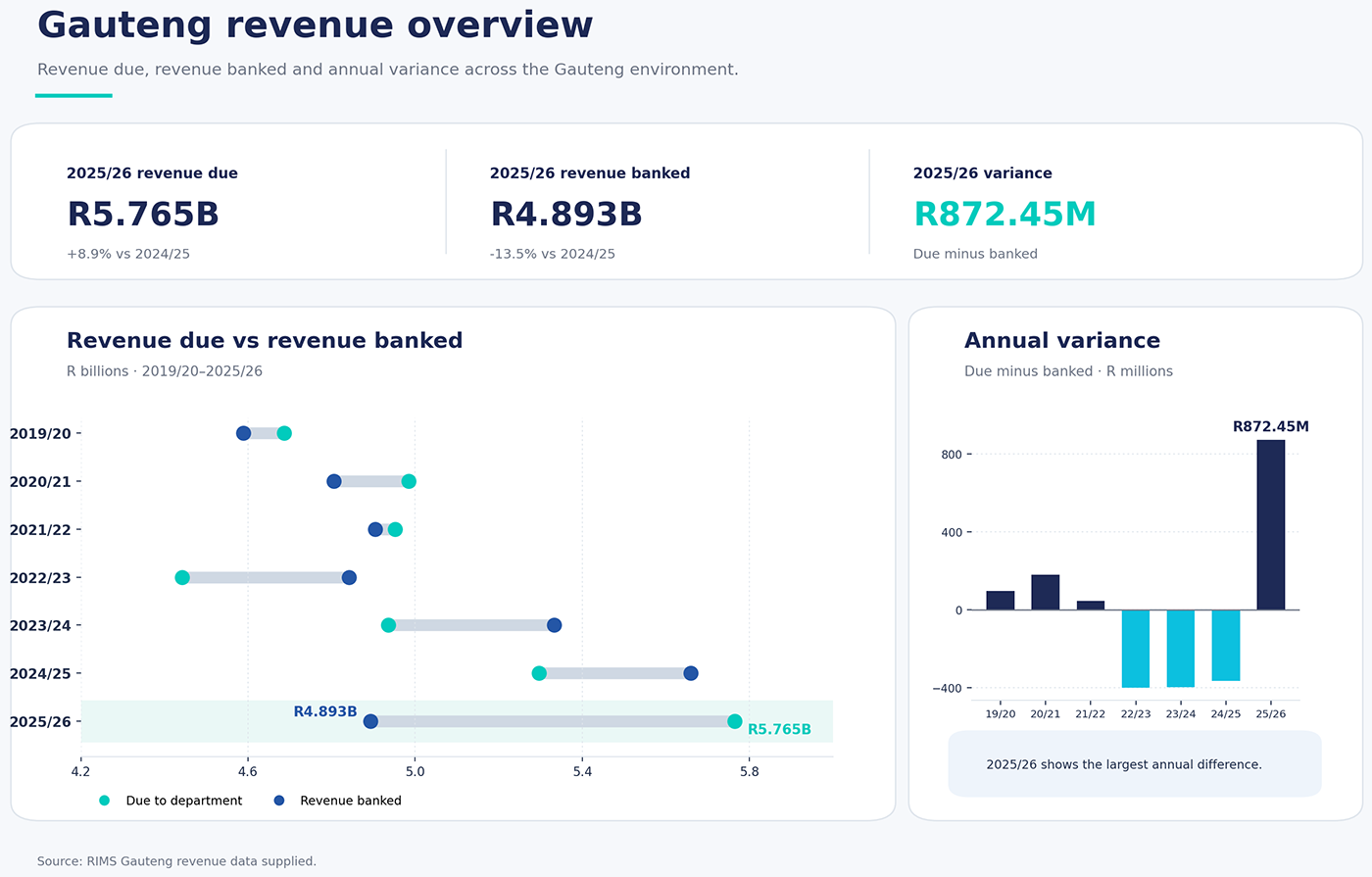
Revenue due to the Department vs Revenue banked

Image link

Both revenue due and revenue banked increased over the review period. Variance remained contained relative to the scale of the total revenue environment.

RIMS strengthened visibility, reconciliation and allocation control as the environment grew.

BOTTOM LINE
RIMS established the control infrastructure required to manage revenue integrity at provincial scale. It connected fragmented payment, banking, operational and reporting processes into a governed revenue flow. This improved reconciliation, strengthened allocation control, increased transaction traceability and supported more timely and defensible reporting across a complex, high-volume transport environment.
Want to strengthen revenue control in your environment?
REQUEST A DEMO
Give us a call

Available from 9am to 8pm, Monday to Friday.

Send us a message

Send your message any time you want.

Our usual reply time: 1-2 Business days