Case Study

Mpumalanga DCSSL

Establishing control over revenue allocation and eliminating unallocated balances

RIMS transformed a fragmented, manual revenue environment into a controlled, automated and audit-aligned operation—delivering measurable improvements in reconciliation, allocation, compliance and revenue visibility.

The Mpumalanga Department of Community Safety, Security and Liaison operates a complex, multi-stream revenue environment across permitting, compliance, licensing and enforcement functions. Before RIMS, fragmented systems, manual processes and inconsistent payment referencing resulted in unallocated funds, reconciliation delays, audit findings and limited visibility over the department’s revenue position.
RIMS was implemented in 2018 to standardise and automate reconciliation, integrate bank and permit data, and establish continuous control over revenue allocation and reporting.

Key Outcomes

96%

Reduction in reconciliation time

< 48 hrs

Allocation delays reduced from 7–14 days to under 48 hours

R0

Unallocated balances eliminated and sustained

100%

Audit findings relating to untraced revenue eliminated

R1.61B

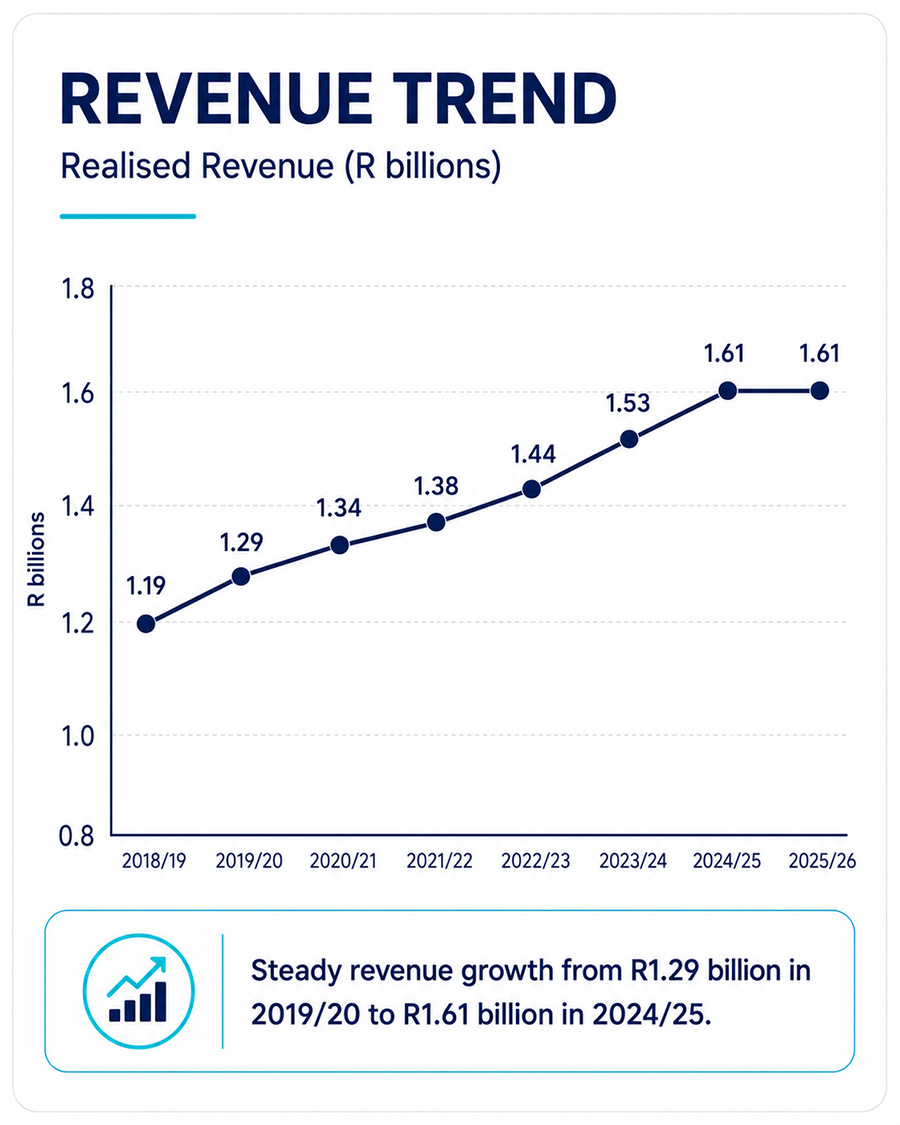
Realised revenue in 2024/25 (up from R1.29B in 2019/20)

Proven results

Revenue growth (2019/20 - 2024/25)

R1.29 billion to R1.61 billion

Image link

Revenue realised increased from R1.29 billion in 2019/20 to R1.61 billion in 2024/25, reflecting growth within the department’s operating environment.

Due vs Banked Revenue

Variance reduced to below R30 million per year on average

Image link

Significant variances in earlier periods reduced substantially after implementation. From 2021 onwards, the average annual variance between revenue due to the department and revenue banked was less than R30 million.

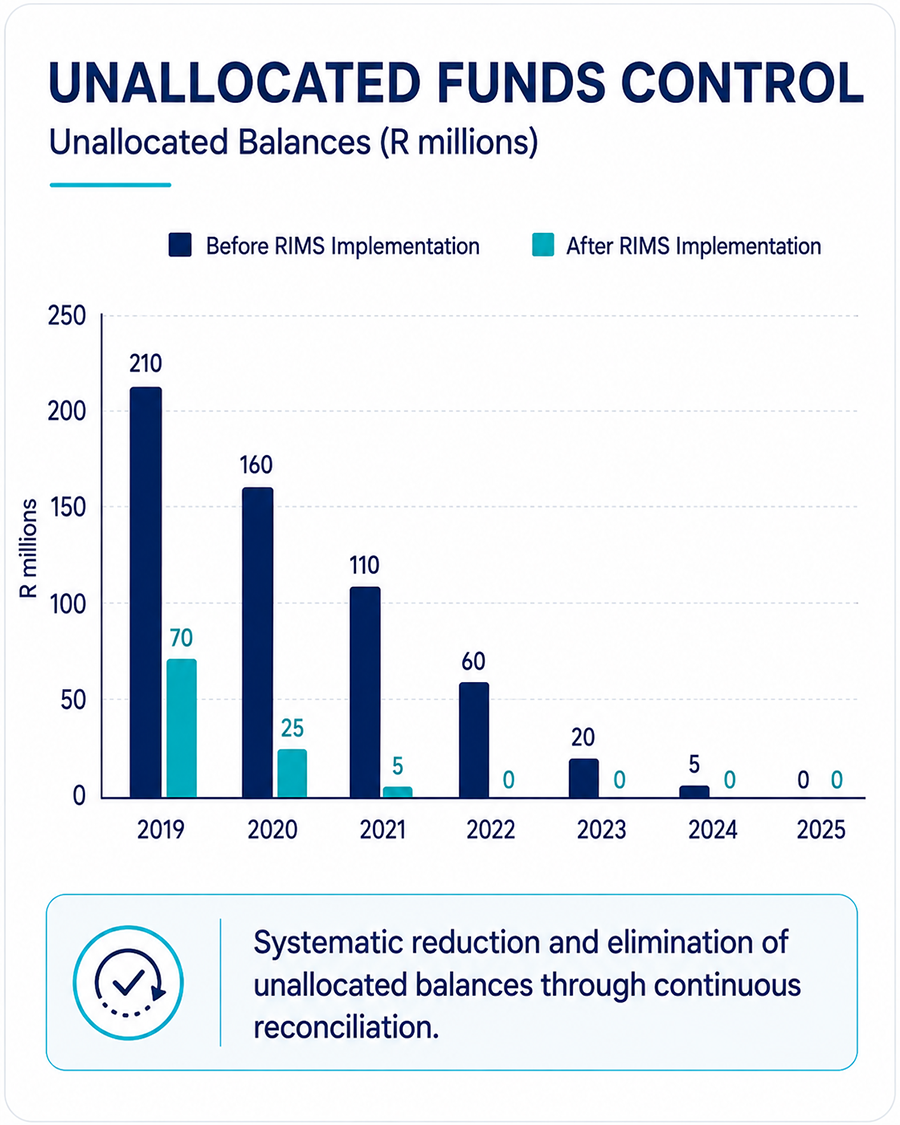
Unallocated funds control

Unallocated balances systematically cleared

Image link

Continuous reconciliation and exception management enabled the department to identify, allocate and clear unallocated funds, including sustained periods where balances were reduced to zero.

What changed

Before RIMS
Reconciliation was manual and fragmented across regions.
Unallocated funds were not consistently visible or actively managed.
Reporting was delayed and inconsistent.
Revenue could not always be traced across permits, payments and bank records.
Audit exposure remained high.
After RIMS
Reconciliation became centralised, automated and continuous.
Unallocated funds became visible and actively managed.
Reporting became timely, accurate and aligned with Treasury requirements.
Revenue became traceable across permit systems, payment records and bank data.
Audit findings relating to untraced revenue and bank-statement gaps were eliminated.

Why it worked

Traditional approaches treated reconciliation as an activity performed after transactions had already moved through the revenue environment.

RIMS embedded reconciliation within the revenue flow.

It standardised payment and allocation structures, integrated bank and permit data, automated transaction matching and gave authorised users continuous visibility over exceptions.

This shifted the department from retrospective reconciliation to active revenue control.

Establish control across your revenue environment

RIMS integrates fragmented systems and embeds continuous reconciliation across the revenue lifecycle—ensuring that revenue remains visible, traceable and accounted for.

Image link
Give us a call

Available from 9am to 8pm, Monday to Friday.

Send us a message

Send your message any time you want.

Our usual reply time: 1-2 Business days