
1. Beyond collection: Who controls government revenue?
Effective management of road-traffic revenue requires more than collecting payments. Provincial transport authorities must be able to establish what was collected, where funds were deposited, what remains outstanding and whether every transaction can be accounted for.
This becomes more complex when revenue moves through multiple municipalities, registering authorities, collection agencies and banking arrangements. Where collection and banking activities sit outside the accountable department’s direct control, gaps can arise between institutional responsibility and the actual movement of funds.
The challenge is not simply whether revenue was collected, but whether the department can verify and account for it.
2. Mpumalanga: Strengthening departmental control
The Mpumalanga Department of Community Safety, Security and Liaison provides a practical example of strengthening control over road-traffic revenue.
By assuming responsibility for certain services previously delivered by municipalities, including their associated operations and revenue collection arrangements, the department has strengthened its direct oversight of these activities.
This extends beyond changing where funds are deposited. It involves managing the services themselves, the collection processes and associated banking arrangements.
RIMS supports the department by integrating revenue information across collection points, banking records and transaction systems. Electronic cash-ups through the Remote Console, automated bank statement processing, NaTIS integration and reconciliation through the RIMS Web Portal provide transaction-level traceability from collection to allocation and reporting.
Importantly, automation supports rather than replaces departmental oversight. Officials remain responsible for verifying allocations, investigating discrepancies and resolving exceptions.
3. Measurable improvements in revenue control
Mpumalanga previously relied heavily on manual reconciliation, spreadsheets and physical cash-up documentation. These processes created administrative delays, particularly when information had to be collected from geographically dispersed offices.
The introduction of system-driven processes achieved a reported 96% reduction in reconciliation time, reducing manual effort and allowing officials to focus more attention on exceptions and outstanding allocations.
The timing of reconciliation provides further insight into how the process operates. As the graphic below illustrates, analysis of 8,335 reconciliations during 2025/26 shows that offices frequently complete sign-off in the afternoon, while verification typically takes place the following morning. Although 61.6% of reconciliations are verified on a later calendar day, the median wait of 17.1 hours largely reflects the overnight gap between processing stages. The subsequent final sign-off step takes a median of just 16 minutes.

Figure 1: Reconciliation delays largely reflect the overnight gap between sign-off and verification, rather than slow processing.
Continuous reconciliation also enables earlier identification of discrepancies, improves month-end processing and strengthens the audit trail by linking reported amounts to source transactions and supporting documentation.
For government departments, this means less time spent on manual reconciliation, earlier visibility of outstanding amounts and more reliable financial information for month-end closing, reporting and audit.
4. Departmental control and reconciliation must work together
Mpumalanga’s experience demonstrates two complementary requirements for effective financial governance. Departmental control establishes responsibility for services, revenue collection and banking arrangements. Revenue integrity ensures that collections can be reconciled against bank receipts, correctly allocated and supported by transaction-level evidence.
Neither replaces the other. Direct control of revenue collection does not automatically establish that every transaction has been accounted for, just as financial reports alone do not prove the integrity of the underlying revenue flow.
Transaction-level analysis of 51,318 links shows significant differences between payment methods. As the graphic below illustrates, 99.9% of Speedpoint transactions are utilised within one day of the bank deposit date, compared with only 17.6% of EFT transactions. EFTs have a median timing difference of five days, while 12.4% exceed 30 days. These figures highlight the importance of identifying outstanding transactions and understanding when bank deposits are linked to cash-ups.
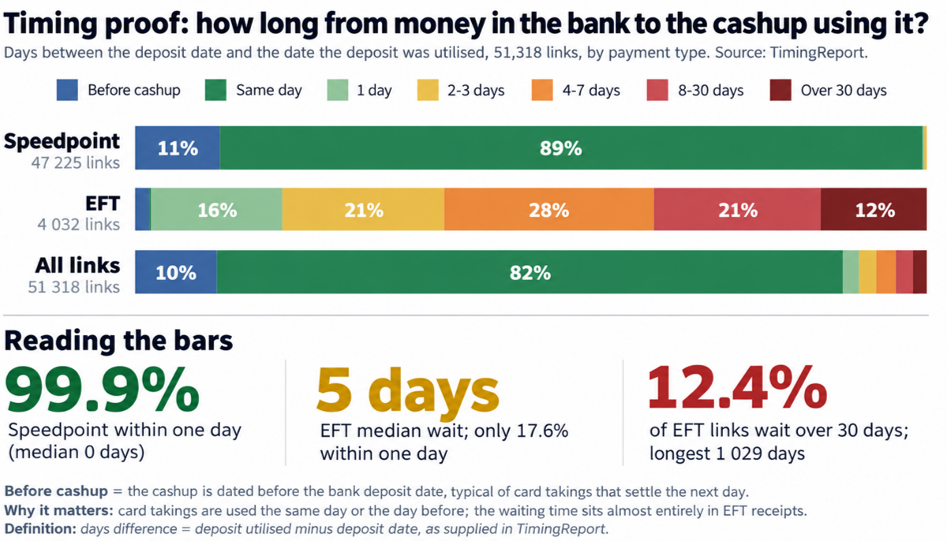
Figure 2: EFT transactions account for most extended deposit-to-cash-up timing differences, highlighting the importance of transaction-level visibility and exception management.
Drawing on experience processing more than 281 million transactions across live operational environments, RIMS supports government institutions in strengthening revenue integrity through integration, continuous reconciliation and transaction traceability.
The lesson from Mpumalanga is clear: effective revenue governance requires more than knowing how much has been collected. Institutions must be able to demonstrate where the money is, who controls it and how every transaction is accounted for.